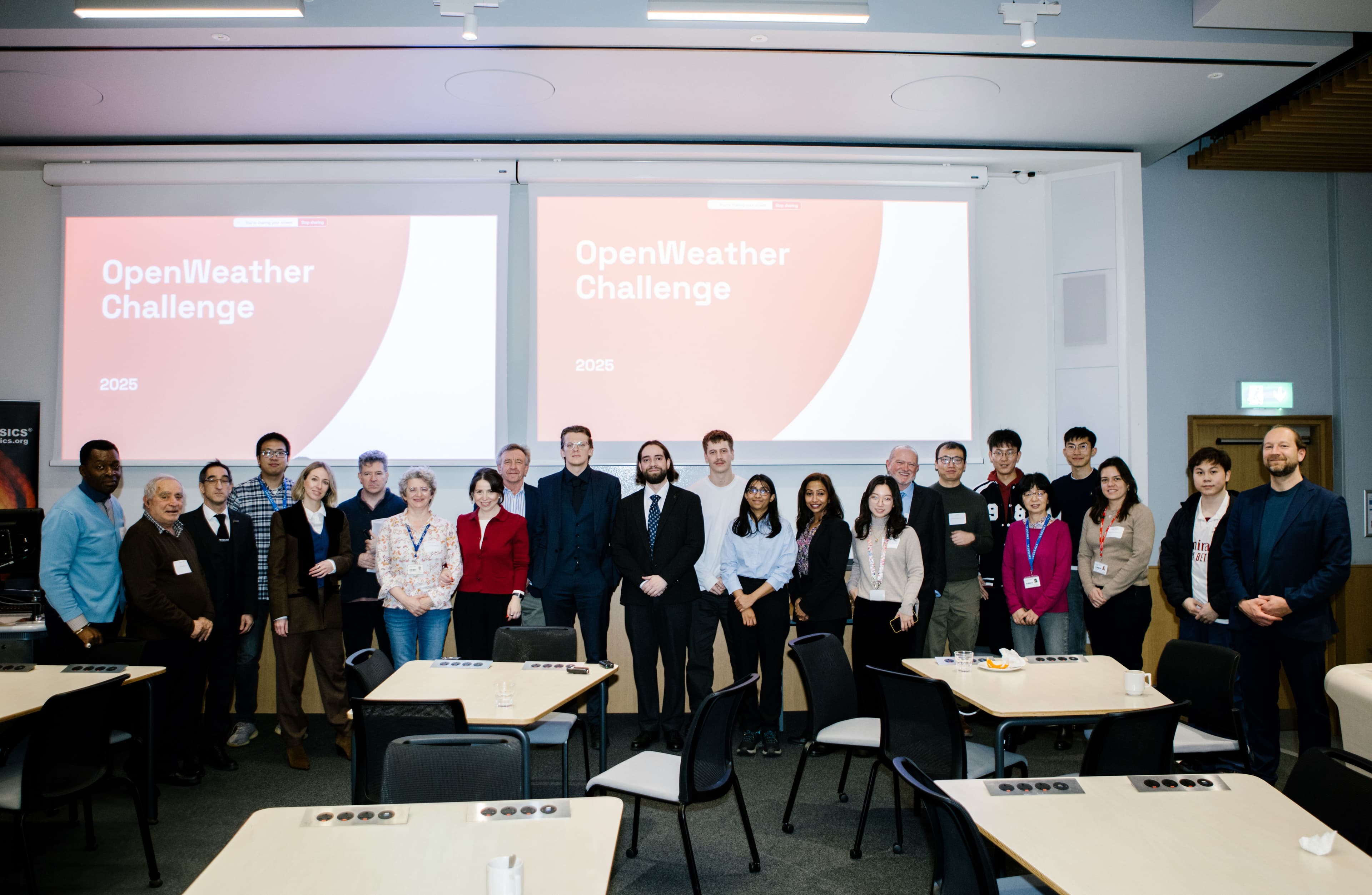
Yesterday, the OpenWeather team, alongside our academic partners and finalists, gathered at Imperial College London (ICL) for the OpenWeather Challenge Award Ceremony. The event marked the conclusion of a significant global initiative designed to explore new frontiers in meteorological data usage.
The core objective of the OpenWeather Challenge was to address the rapid pace of technological advancement by encouraging the invention and discovery of novel ways to utilize weather information for the betterment of our planet. The response from the global developer and scientific community was substantial. We received over 400 submissions from every continent, serving as a testament to the growing interest in leveraging meteorological data for research, analysis, and application development.
A Collaborative Effort
The success of this challenge was driven by the expertise and support of our partners. We would like to extend our gratitude to our lead partner, Imperial College London, for hosting the ceremony and helping us steer the challenge toward such high-quality outcomes.
We also thank our supporting partners for their invaluable involvement:
- Dr. Linbing Wang, University of Georgia
- Professor Prashant Kumar, University of Surrey
- Professor Rosie McEachan, University of Bradford (Born in Bradford)
- Dr. Romit Maulik, Pennsylvania State University
- IMS Ahmedabad Chapter, Indian Meteorological Society
The Winning Projects
The judges faced a difficult task in selecting the top entries from such a diverse pool of talent. However, three projects distinguished themselves through their technical execution, innovative use of OpenWeather APIs, and their potential for positive social and environmental impact.
1st Place: Ashley Turner - Imperial College London (United Kingdom)
WIRE (Weather-Induced Risk Exposure)
Taking the first place prize was WIRE, a specialized global hazard-assessment system designed to assist organizations with duty-of-care responsibilities, such as care homes, schools, hospitals, and local councils.
While standard weather apps provide general forecasts, WIRE focuses on risk mitigation for vulnerable populations. The system analyzes meteorological and air-quality data to generate eight distinct hazard scores, covering heat stress, cold exposure, respiratory risk, slip/fall hazards, storm severity, flood risk, dehydration, and travel visibility.
Each hazard is scored on a 1–5 scale and paired with tailored recommendations specifically designed for the elderly, children, or patients. Built using Python and a Next.js frontend, WIRE delivers real-time and 5-day forecasts, providing care managers with a clear, institutional user interface. This tool exemplifies the challenge's goal by transforming raw weather data into actionable safety protocols that can save lives and improve operational planning in the public sector.
2nd Place: Ivander Andreas Wijaya - Universitas Indonesia (Indonesia)
AIRAware
The second-place award went to AIRAware, an environmental health application that visualizes a hidden danger: airborne microplastics.
Most environmental apps focus solely on the Air Quality Index (AQI), but AIRAware digs deeper. The project correlates real-time weather variables, specifically wind speed, atmospheric pressure, and precipitation, with PM2.5 concentrations to estimate the transport and "washout" dynamics of microplastics.
The application features an interactive map that highlights "Washout" events during rainfall and "Transport" corridors where wind may carry microplastic particles. By utilizing a custom AI backend to interpret this atmospheric data, AIRAware produces accessible health guidance, helping users understand exposure risks and the physics behind microplastic movement. It is a forward-thinking solution that brings visibility to an often-overlooked environmental threat.
3rd Place: Madara Premawardhana - University of Buckingham (United Kingdom)
WeatherSim (Unreal Engine Integration)
Securing third place was a project that bridges the gap between the physical and digital worlds. This solution integrates the OpenWeatherMap API with Unreal Engine 5 and the Ultra Dynamic Sky plugin to create a real-time, location-based weather simulation system.
The system fetches live weather data, including temperature, wind speed, precipitation, and cloud coverage, and dynamically updates a virtual environment to reflect real-world atmospheric conditions. Sky color, lighting, fog, and sun position are adjusted automatically. This "digital twin" capability allows for time synchronization with target locations and customizable weather-to-visual mapping. The implications for this technology are vast, offering potential use cases in gaming, VR simulations, architectural planning, and education, effectively mirroring the real world inside a 3D interactive space.
Recognizing Our Finalists
The breadth of innovation displayed in this challenge was inspiring, and will be showcasing some of these in future articles. Beyond our top three, we want to acknowledge the other finalists who developed impressive solutions ranging from agricultural tools to smart city platforms:
- Nukus State Technical University (Uzbekistan)
- Adamas University (India)
- UC Labs LLC
- Pratap Institute of Technology & Science (India)
- The Catholic University of America (USA)
- Madhav Institute of Technology & Science (India)
- Haverford College & Bryn Mawr College (USA)
- Universiti Malaya (Malaysia)
The OpenWeather Challenge has highlighted the critical role that accessible, high-quality data plays in solving modern problems. Whether it is improving public health in the UK, tracking pollution in Indonesia, or simulating environments in the digital realm, these projects demonstrate that the potential of weather data extends far beyond a simple forecast.
We congratulate all the winners and participants for their contributions and look forward to seeing how these projects evolve.
Weather Foundation™
The Weather Foundation provides educational support for the Challenge, promoting open access to meteorological data. By offering free API access to students and researchers, the Foundation eliminates the costs that typically restrict experimental development. This commitment ensures the OpenWeather Challenge remains focused on ingenuity rather than budget, empowering participants to build practical climate solutions using professional-grade tools.