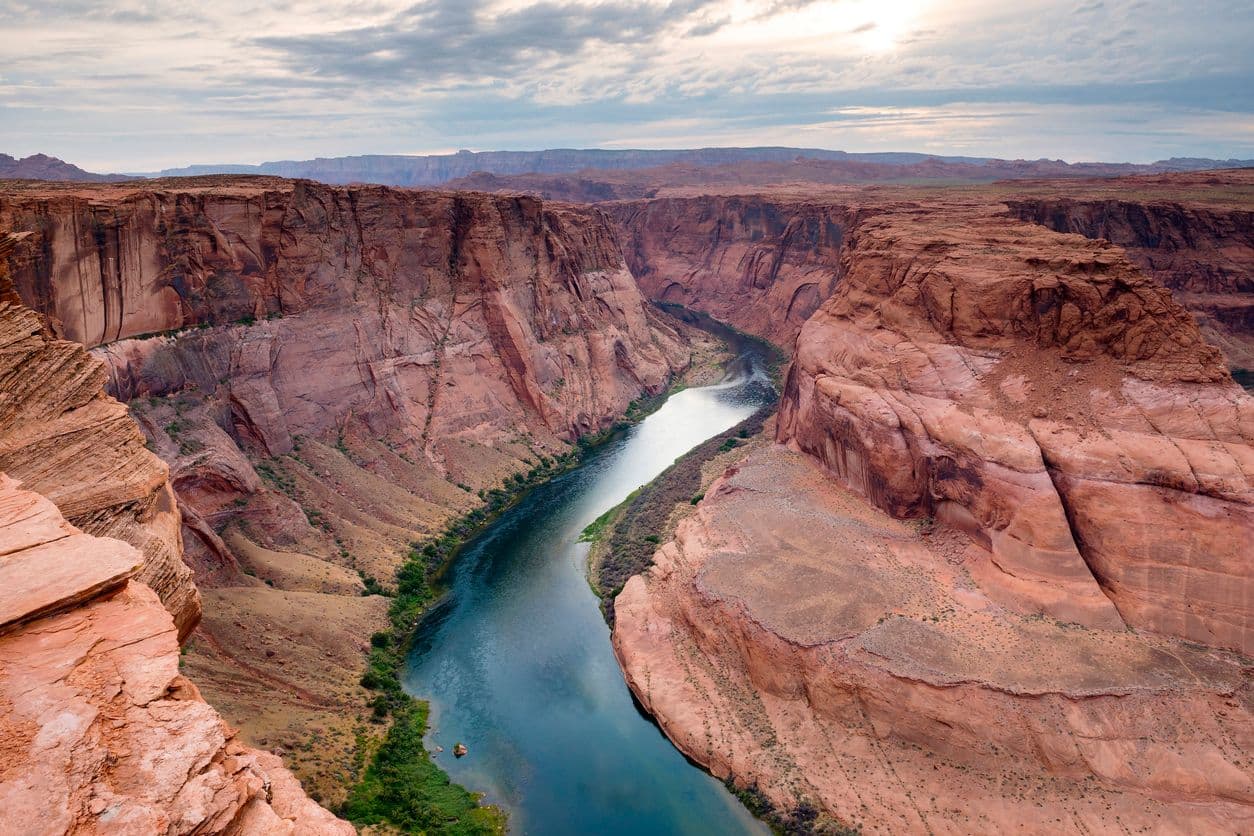
The Colorado River, the lifeblood of 40 million people in the American West, is at a critical juncture. The recent November 2025 federal deadline for the seven basin states to agree on a new, sustainable water-sharing plan has passed without a comprehensive deal. This impasse highlights a fundamental challenge: the region's climate is not just in a "drought," but is experiencing long-term "aridification."
The policies and agreements of the past century were built on assumptions of a wetter climate. To navigate this drier "new normal," water managers, agricultural producers, and government agencies must anchor their strategies in a new baseline, one defined by modern, long-term data.
Shifting from "Drought" to "Aridification"
For over two decades, the Colorado River basin has experienced what is often called a "megadrought." This term, however, implies a temporary condition that will eventually end. The reality, supported by extensive climate research, is that this is a permanent shift. Aridification is a long-term reduction in water availability driven by a changing climate.
Warmer temperatures lead to more evaporation from soil and reservoirs like Lake Mead and Lake Powell. Perhaps most critically, they reduce the mountain snowpack that is the primary source of the river's flow.
The original 1922 Colorado River Compact, which divided the river's water, was based on data from an unusually wet period. This has created a structural deficit, allocating more water than the river often carries. The current negotiations are stalled precisely because this old math no longer works. To move forward, stakeholders need a clear, shared understanding of exactly how much water is available now and is likely to be available in the future.
The Power of a 40-Year Lookback
Creating realistic and fair water management plans is impossible when relying on outdated, 100-year-old averages. This is where comprehensive historical weather data becomes an essential tool for planners.
By analyzing the past 40 to 45 years, a period that captures the clear trend of the region's aridification, state and local water agencies can build robust models that reflect the river's current reality.
A deep archive of Historical Weather Data, such as that available through the OpenWeather One Call API 3.0, could provide the necessary inputs for these next-generation models. The OpenWeather History Bulk enables you to extract hourly historical weather data for over 47+ years deep for any chosen location or coordinate, and the History Forecast Bulk allows you to extract historical forecast weather data from October 7, 2017 for any location on the globe. Water managers could query decades of granular data for the crucial Upper Basin states, where most of the river's water originates.
They could track precise historical precipitation data using the OpenWeather Historical Products Collection to see how patterns have changed. They could layer in historical temperature data to quantify the impact of rising heat on evaporation and snowmelt timing. This information allows for a highly accurate proxy for snowpack, the most critical variable. By analyzing decades of winter precipitation and temperature data at high altitudes, planners can see the clear, declining trend in spring runoff. This is the data that proves the "new normal" and provides the statistical foundation for new, sustainable water-sharing agreements.
Adapting on the Ground with Smarter Irrigation
This data-driven approach also extends to the end-users of the river's water. Agriculture uses the largest share of the Colorado River, and farms in states like Arizona and California are facing significant supply cuts. To remain viable, these agricultural communities must maximize the efficiency of every gallon.
This is where precision agriculture becomes critical. Farmers need timely, field-specific data to manage irrigation with pinpoint accuracy.
Tools found in the OpenWeather for Agriculture Collection can be instrumental in this adaptation, helping farmers shift from a calendar-based irrigation schedule to one based on real-time conditions. With such a service, a farmer could access a dashboard for their specific fields, allowing them to:
- Monitor current soil moisture and temperature at various depths.
- Calculate daily evapotranspiration (the water lost from soil and plants) based on local weather.
- Receive precise recommendations on when and how much to irrigate.
This technology helps produce "more crop per drop," building resilience from the ground up and reducing the overall strain on the river system.
A Data-Driven Path Forward
The challenge facing the Colorado River basin is immense, but it is not insurmountable. The path forward requires letting go of 20th-century assumptions and embracing the realities of a 21st-century climate.
The key to a resilient future lies in data. By leveraging deep historical weather archives to redefine our baseline and using smart, real-time tools to manage on-the-ground consumption, we can build the sustainable framework the river and its 40 million dependents urgently need.