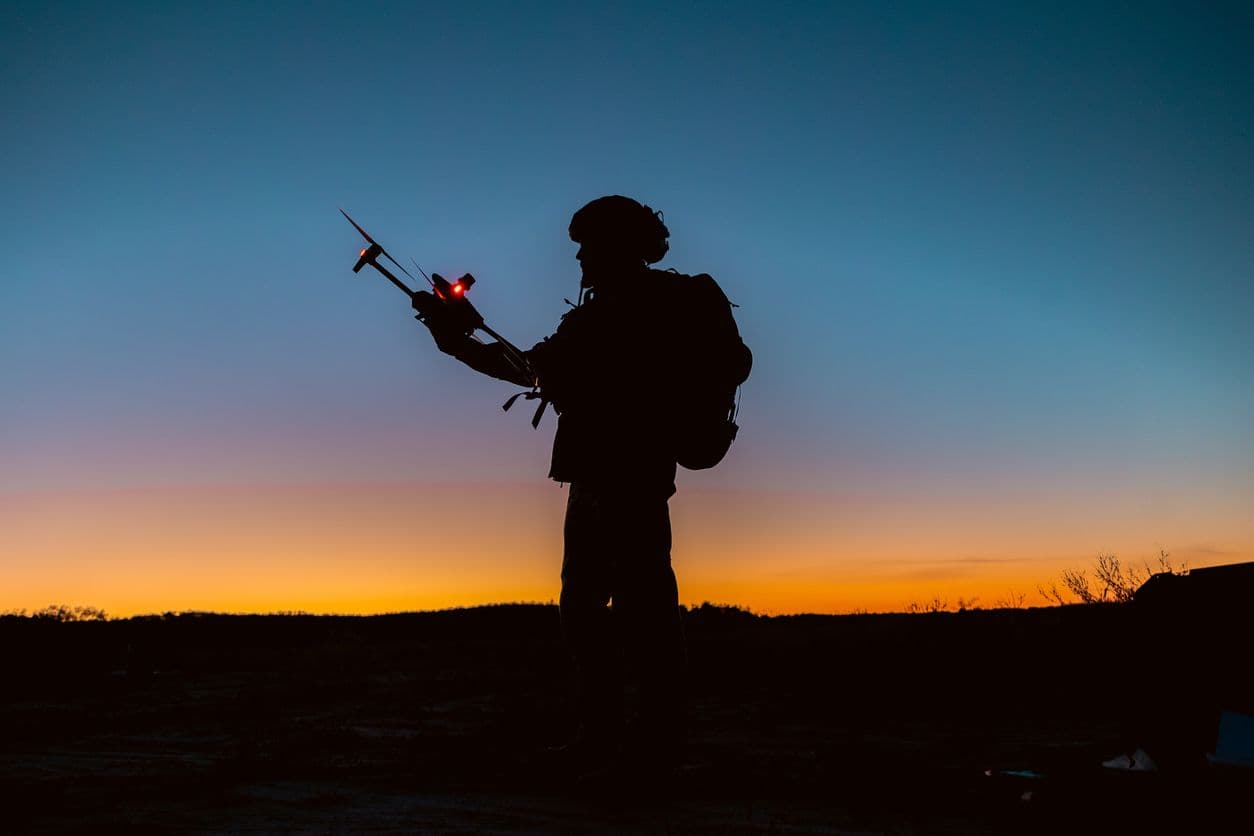
Unmanned aerial vehicles are now central to how modern conflicts are fought. But their most persistent adversary is not enemy action, it is the atmosphere. Weather does not care how sophisticated the platform is.
UAVs have moved from the experimental margins of military doctrine into its operational core. From intelligence gathering and precision strike to logistics and electronic warfare, drones are now decisive assets across every domain. The war in Ukraine demonstrated this at scale: low-cost autonomous platforms can reshape the balance of power between forces of very different sizes. But wind, precipitation, temperature, icing, and turbulence affect every airborne platform regardless of its sophistication. The smaller and lighter the platform, the more acutely it feels those effects.
Understanding how weather interacts with UAV operations - at the tactical level of a single mission and the strategic level of a campaign - is becoming one of the defining competencies of modern military capability.
Why weather grounds drones before the enemy does
Wind is the most operationally immediate variable. For small tactical UAVs, crosswinds and gusts impose hard performance limits. A platform with a maximum tolerance of 15 m/s is effectively grounded in conditions that would barely register for manned aviation. Critically, it is gusts rather than sustained wind that most frequently cause loss of control - a UAV navigating a steady 12 m/s headwind may be well within its envelope, while a 18 m/s gust during approach or hover can be fatal to the mission. In complex terrain: urban canyons, mountain valleys, coastal cliffs, turbulence generated by wind interacting with surface features creates highly localised conditions that no area-wide forecast can capture.
Precipitation degrades aerodynamic surfaces, sensor domes, antennas, and infrared performance simultaneously. At near-freezing temperatures, the transition from rain to freezing rain can ice control surfaces within minutes with no pilot able to intervene. Temperature extremes compound these problems: cold reduces battery endurance sharply for lithium-polymer powered platforms, while heat reduces air density and degrades lift. In high-altitude, high-temperature environments across Central Asia and the Middle East, performance envelopes can shrink far below manufacturer specifications. At the strategic level, the jet stream drives the dominant weather patterns across entire theatres. A southward-displaced jet stream in winter locks persistent cold, low cloud, and snow across a theatre, systematically degrading sortie rates. Climate change is making jet stream behaviour less predictable, with more frequent and persistent blocking patterns creating extended adverse weather windows that campaign planning must account for. The atmosphere is not a neutral medium through which UAVs fly. It is a domain ofcompetition in its own right - one that advantages the side with better atmospheric intelligence.
What UAV operations actually need from weather data
Standard meteorological products are not designed for UAV mission planning. A regional forecast at multi-kilometre resolution tells an operator little about conditions at rooftop level in a target urban block, or in the lee of a ridge, or across a valley where thermal circulation changes conditions within metres. UAV weather intelligence requires point-specific data at the exact location and altitude of the operation, at update frequencies that keep pace with rapidly evolving conditions, and critically it requires wind data not just at the surface but through the full vertical column in which the platform will fly.
This last requirement is decisive. Wind shear - where wind speed or direction changes significantly across a short vertical distance - can place a UAV in operationally very different conditions from those observed at ground level. A platform launched in acceptable surface conditions may encounter gust regimes at 100 or 300 metres that exceed its tolerance. Without altitude-resolved wind data, mission planners are making go/no-go decisions on incomplete information.
This is precisely the gap that OpenWeather’s OWHL™ Hyper-Local Forecasting Model closes. Where conventional forecasts operate at kilometre-scale resolution, OWHL™ delivers short-range forecasts at 100 m resolution updated every minute, fine enough to distinguish conditions at rooftop level, in the lee of a ridge, or across a valley where airflow changes within metres. The model continuously fuses data from weather stations, radar networks, satellite imagery, and global forecasting models, with machine learning correcting biases and producing a unified, high-confidence output refreshed roughly every 10 minutes. For the immediate mission window, the OWHL™ NIR (Nowcast Immediate Range) component provides forecasts up to 3 hours ahead, drawing on real-time radar, satellite imagery, and sensor data and updating every minute. This is the product that addresses the hardest UAV planning problem: not what conditions will be in six hours, but what they will be at the target location in the next 30 minutes, when a go/no-go decision cannot wait for the next forecast cycle. For multi-day campaign planning, mid-range and long-range forecasts extend the picture further, at 2 km resolution updated hourly, drawing on globally respected models including ECMWF, NOAA GFS, and WRF.
How OpenWeather supports UAV operations
OpenWeather’s Defence & Secure Operations solution combines hardware, a secure data platform, advanced modelling, and expert human analysis into a modular architecture that can complement sovereign forecasting capabilities or operate as a primary source where national services cannot reach.
Hardware forms the ground truth layer. Deployable and fixed industrial-grade weather stations and sensors can be positioned at bases, training areas, remote assets, and temporary operating locations — including forward positions where no fixed infrastructure exists. The hardware is vendor-agnostic and compatible with existing MOD and third-party systems, and data ownership remains with the customer at all times. The OWM Cloud secure data platform aggregates sensor data with feeds from satellites, radars, METAR reports, and external agencies, applying advanced quality control throughout. Critically for defence use, the platform is hosted on UK-based infrastructure and supports private cloud, restricted, and on-premises deployment options. APIs allow direct integration into existing defence platforms and mission planning systems.
Wind Intelligence & Monitoring Solutions directly addresses the vertical wind challenge central to UAV operations. It delivers wind speed and direction at custom heights from 0 to 1,000 metres above ground level, providing a full altitude-resolved wind profile through the entire operating band of tactical, MALE, and HALE-class UAVs. At 15-minute forecast resolution over a 16-day horizon, planners can interrogate the wind profile simultaneously at 50 m, 200 m, and 500 m — identifying wind shear layers where platform margins may be unexpectedly tight. Extreme wind alerts automate threshold monitoring for operations rooms managing multiple assets simultaneously.
Current & Forecast Intelligence provides the broader operational weather picture across minute, hourly, daily, and long-range timescales. For active mission monitoring, the minute-level nowcast tracks the onset of precipitation, visibility changes, and rapid temperature drops faster than a standard forecast cycle captures. Combined with the altitude-resolved wind profiles, it delivers a complete atmospheric picture from the surface to altitude, accessible via API or direct integration into mission planning and operations platforms. Meteorologists and analysts provide the human layer that automated systems cannot replace. Expert interpretation and operationally focused validation supports decision confidence in high-stakes scenarios, a critical safeguard when mission outcomes depend on correctly reading a rapidly evolving atmospheric situation, not simply receiving a data output. The capability is explicitly designed as a second-opinion and contingency layer alongside sovereign meteorological services, providing independent assurance, overseas and denied-environment coverage, and the operational resilience that safety-critical UAV programmes require.
The atmosphere as a domain of competition
The pioneers of military aviation learned that weather was not a backdrop to operations but a participant in them — an actor that could ground entire fleets and decide engagements before a shot was fired. UAVs have sharpened that truth, not changed it. Smaller platforms are more weather-sensitive, their proliferation has extended operations into environments where manned aviation would not operate, and their autonomy depends on sensors and communications links that atmospheric conditions can degrade or deny.
The forces that will extract the most operational value from UAVs are those that treat atmospheric intelligence not as a support function, but as a core operational enabler, as fundamental to mission success as the platform, the payload, and the operator.