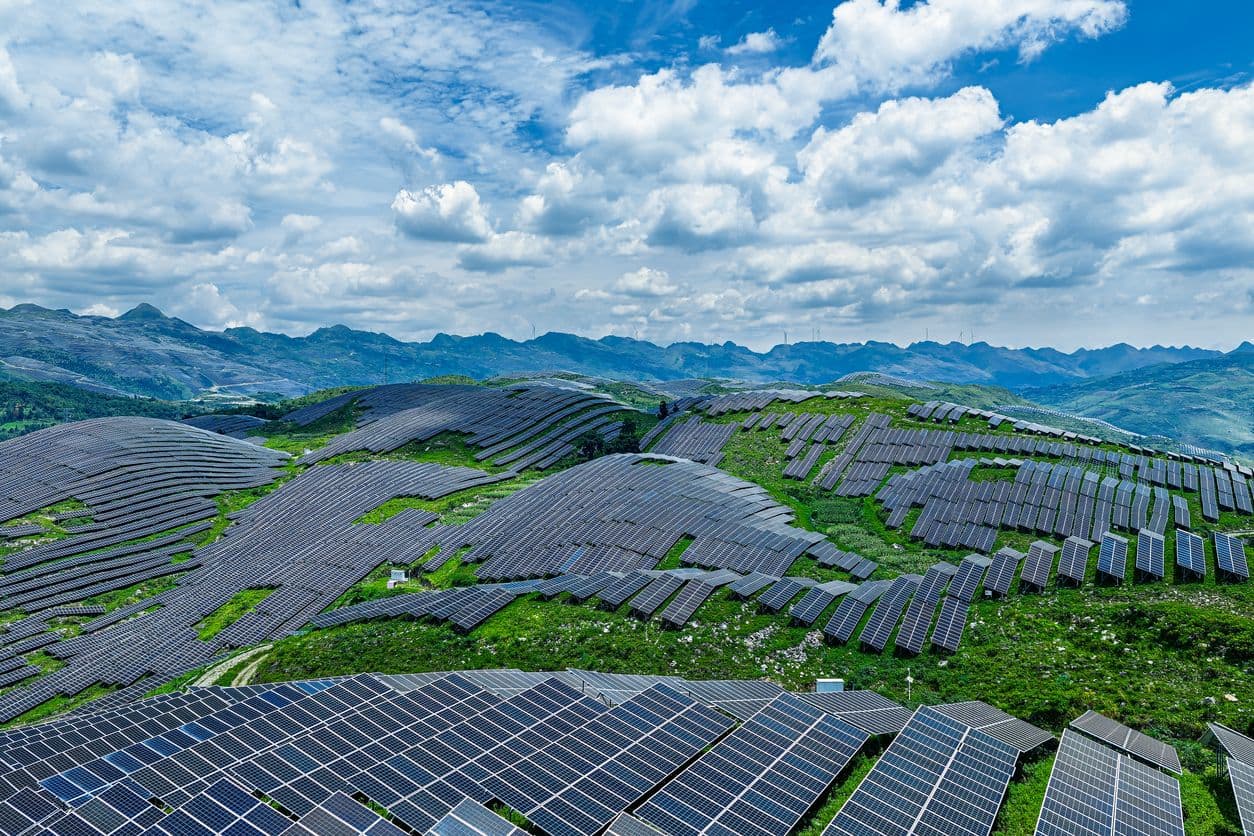
China is building clean power really fast and, increasingly, throwing some of it away. Even as roughly 262 GW of utility-scale solar and 251 GW of wind sit under construction simultaneously, national curtailment has climbed to around 9.2% for solar and 8.5% for wind in early 2026, up from about 6% a year earlier. Both figures are now pressing against the 10% ceiling that Chinese regulators have historically treated as the point at which construction slows down, and in northwestern provinces such as Qinghai, Xinjiang and Gansu, solar curtailment has already pushed well past that mark.
Curtailment is the most visible symptom of a deeper problem: variable generation that the grid cannot place with confidence. Solar PV is a cornerstone of the energy transition, but it is also intermittent, and for grid operators, energy traders and solar farm managers, predicting exactly how much power a facility will produce in a given hour is now as commercially important as the panels themselves. When those predictions miss, the cost is real, and it lands directly on the operator.
The economic cost of inaccuracy
The financial impact of forecast error shows up first as imbalance cost. Energy markets run on precise schedules: producers commit to supplying a specific quantity of electricity in day-ahead and intraday markets, and they are settled against what they actually deliver.
When a solar farm generates less than forecast, the grid operator must instantly fill the gap to hold the system stable. That replacement power typically comes from fast-acting reserves such as gas peaker plants (expensive to run and carbon-intensive) and the solar operator is charged an imbalance penalty for the shortfall, eroding already thin project margins. Over-forecasting carries its own cost: schedule more output than the grid can absorb and the operator may be forced to curtail, discarding generation that has already been produced at near-zero marginal cost. In markets with high renewable penetration, the same conditions can trigger negative prices, where producers effectively pay to offload surplus energy. Profitability in solar, in other words, is not about generating the most power, but about generating predictable power.
Operational challenges on the ground
Beyond market penalties, forecast error disrupts day-to-day asset management. Maintenance scheduling depends on knowing when irradiance will be low, so crews can clean or repair panels without sacrificing production. A forecast that misses an incoming cloud front might leave a maintenance team idle through a sunny window or, worse, take panels offline during peak output. For large parks in arid regions, where dust soiling steadily degrades performance, timing cleaning cycles against accurate rainfall and irradiance forecasts is one of the strongest levers on long-term yield.
Mitigation through granular data
The most effective response to curtailment risk and imbalance exposure is better information: hyper-local, high-resolution meteorological data that captures cloud behaviour over a specific site rather than a wide region. Generic weather models rarely have the spatial resolution to resolve cloud formation over an individual solar farm, and that gap is exactly where forecast error and cost accumulate.
OpenWeather addresses this with the Solar Irradiance and Energy Prediction service. Rather than basic weather metrics, it delivers the solar-specific parameters that generation modelling actually requires: Global Horizontal Irradiance (GHI), Direct Normal Irradiance (DNI) and Diffuse Horizontal Irradiance (DHI), available in both clear-sky and cloudy-sky models. With these indices tied to precise coordinates, developers and analysts can calculate the energy potential of a given site and adjust generation estimates dynamically as conditions change, bringing market commitments closer to physical reality. Recent updates to OpenWeather's underlying solar irradiance model have tightened that accuracy further, narrowing the error margins that drive imbalance penalties in the first place.
Ground truth from onsite stations and sensors
A forecast is only as good as the observations that calibrate it, and the most valuable observations come from the site itself. This is where OpenWeather's integrated solution goes beyond data feeds: alongside the forecast service, OpenWeather deploys its own field-ready hardware directly at the solar farm, so the model is anchored to what is actually happening over the panels rather than inferred from a distant grid cell.
Two instruments matter most for solar operators. The SRM100 Solar Radiation Sensor is a first-level, WRR-traceable pyranometer that measures incoming irradiance across the 285–3000 nm band – a direct, real-time reading of the resource actually reaching the array. The SC100 All-Sky Imager adds a 175° fisheye view of the sky, capturing the approaching cloud fields that drive the sharpest and hardest-to-predict swings in output. Paired with OpenWeather's Series WS weather stations, these sensors stream continuous ground truth that both validates the forecast and feeds back into it, tightening accuracy exactly where generic models are weakest: the local, minute-to-minute behaviour of cloud over a single site.
The result is a closed loop – onsite measurement combined with site-specific forecasting, that turns a wide-area prediction into an asset-level operating picture, and gives traders and operators the confidence to commit generation they can actually deliver.
Strategic benefits of improved accuracy
Investment in high-quality forecasting pays back across the whole project lifecycle:
- Lower imbalance penalties: closer alignment between committed and actual generation directly reduces the fees paid to grid operators for supply deviations.
- Smarter storage dispatch: accurate forecasts let operators charge batteries during predicted excess and discharge into high-price windows, capturing value that would otherwise be curtailed.
- Efficient maintenance planning: scheduling downtime during low-irradiance periods keeps assets fully productive when the sun is strongest.
- Greater grid stability: reliable generation forecasts help operators absorb variable renewables without falling back on fossil reserves — the very pressure now driving curtailment in China's fastest-growing regions.
Data as a stability driver
The solar industry has largely mastered the hardware of energy production. The next frontier is the information layer, and China's rising curtailment is a preview of the challenge every high-penetration grid will eventually face. As networks grow more complex, the value of precise, accessible weather data only rises. By combining forecasting with onsite measurement, the Solar Irradiance and Energy Prediction service helps turn variable solar radiation into something the market can rely on: power that is not just clean, but predictable, dispatchable and profitable.