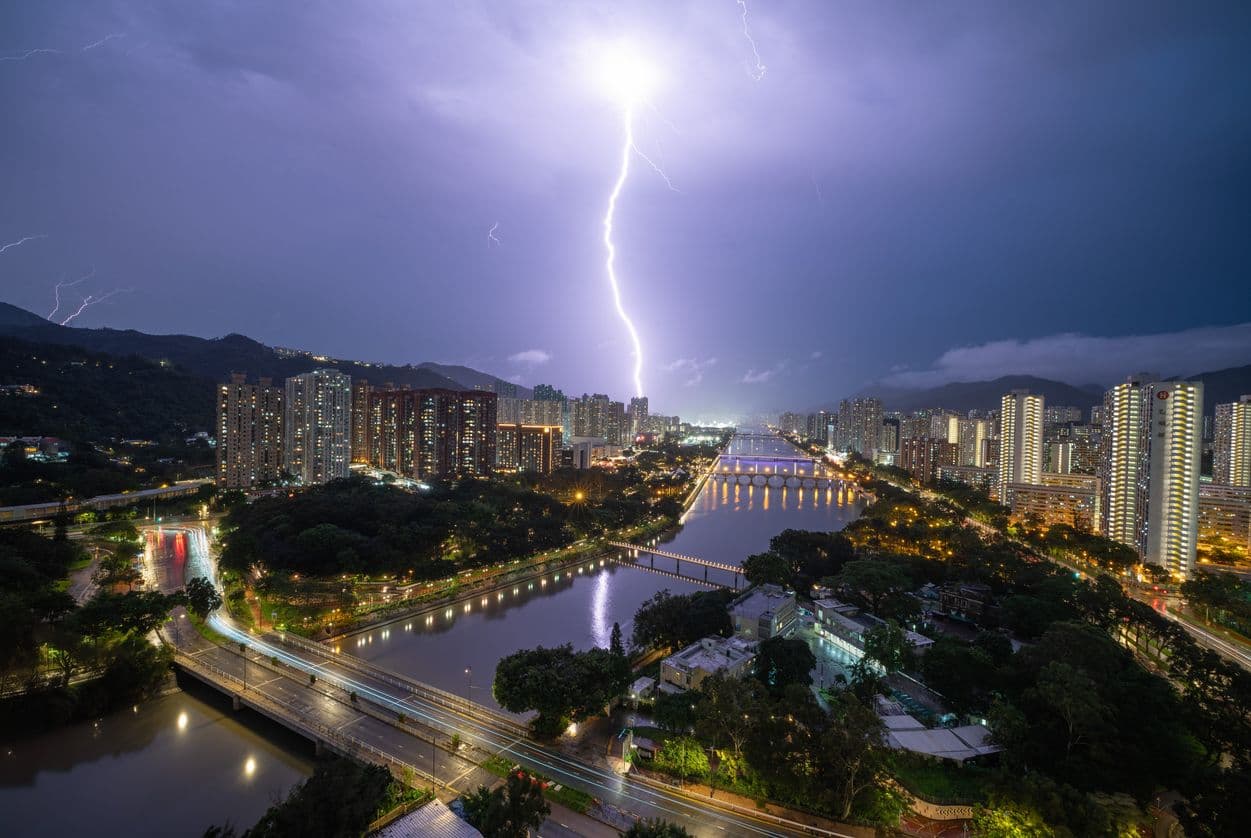
Somewhere in the world, lightning strikes several times every second. Whether you need to know about a strike the moment it happens or verify one that happened months ago, our LightningTracker service now covers both, and now we're introducing a second way to receive its data.
Until now, lightning data from OpenWeather was available on request through our Historical Lighning Data API. We've added a real-time streaming method, so LightningTracker now offers two delivery options within a single service: query the archive, or listen to the live feed.
What's new: live lightning streaming over WebSocket
The new real-time method works differently from a classic API request. Instead of asking for data, you open a single always-on WebSocket connection, and from that moment, every lightning strike detected anywhere in the world is pushed to you the instant it's registered.
Connect once by sending your API key, then an "all stream" message to route your session, and the connection delivers each strike as a compact JSON record containing:
- Date and time of the strike
- Location: exact coordinates of where the strike was detected
- Detection quality: good, medium, bad, or undefined
- Estimated location error: the horizontal uncertainty of the strike position, in kilometres to two decimal places
When the network detects the lightning, you receive notification. That makes it work like a continuous global alert feed, similar to OpenWeather alerts, but for a single, very fast-moving natural phenomenon.
The data is also easy to put on a map. Because every record carries precise coordinates, visualising live strikes in your own application takes minimal effort, and the product page includes ready-to-use code examples to get you started.
View real-time documentation →
And a reminder: the historical lightning archive
The second method is the one our users already know: historical lightning data over standard HTTPS. You define a location, a radius around it, and a time window: for example, 50 km around central London last Tuesday, and the API returns every strike recorded in that area and period.
Each record contains the same fields as the live stream: strike time, coordinates, detection quality, and location uncertainty. Live and historical data return identical record structures, so you integrate once and use both. The archive covers every detected strike since June 2023.
View historical documentation →
Two methods and how they can be used by industries
Although both methods describe the same phenomenon, they serve distinct purposes. Historical data answers "what happened?" – objective verification and analysis after the fact. Real-time data answers "what's happening right now?", like a constant stream powering live monitoring and alerting. Here is how that plays out across industries:
Energy & utilities
Lightning is a major cause of power outages and damage to substations, transformers, and transmission lines. The real-time stream lets grid operators monitor thunderstorm activity around critical assets as it develops and trigger protective procedures before a storm cell arrives. The historical archive supports reliability analysis, infrastructure planning, and investigation of weather-related outages – was that transformer failure really a lightning strike?
Insurance & risk assessment
The Historical Lightning Data API is built for claims verification: insurers can objectively confirm whether lightning struck at a specific location and time, with detection quality and location uncertainty included in every record to support the assessment. Beyond individual claims, several years of global strike data feed risk modelling and underwriting.
Telecommunications
Towers and antennas are among the most lightning-exposed structures there are. Real-time monitoring helps operators track storms approaching their infrastructure and anticipate service disruptions, while historical records inform site planning and network reliability analysis.
Construction & infrastructure
Construction sites combine open environments, tall structures, and people working at height, which is a high-risk mix during thunderstorms. A live lightning feed gives site managers the earliest possible signal to pause work and move crews to safety, and helps document weather-related delays.
Sports & outdoor events
For stadiums, golf courses, festivals, and any large outdoor gathering, lightning is one of the most serious safety risks. Real-time detection lets organisers watch approaching storms and make timely, informed calls on delays, evacuations, or suspension, protecting participants and spectators.
Logistics & transportation
Thunderstorms disrupt ports, airfields, fuel handling, and open-air loading operations. Streaming lightning data helps operations teams pause exposed activities, reroute around active storms, and resume with confidence once activity has passed.
Research & analytics
An unfiltered global archive of every strike since June 2023 is a rich dataset in its own right for climatology studies, storm behaviour analysis, and building or validating severe-weather models.
Start exploring
LightningTracker delivers global coverage. Every coordinate on Earth, including places a ground sensor can't go, through an API that takes minutes to integrate. Both delivery methods are available now.
Explore the service on the LightningTracker page, to learn how lightning data can fit into your operations.